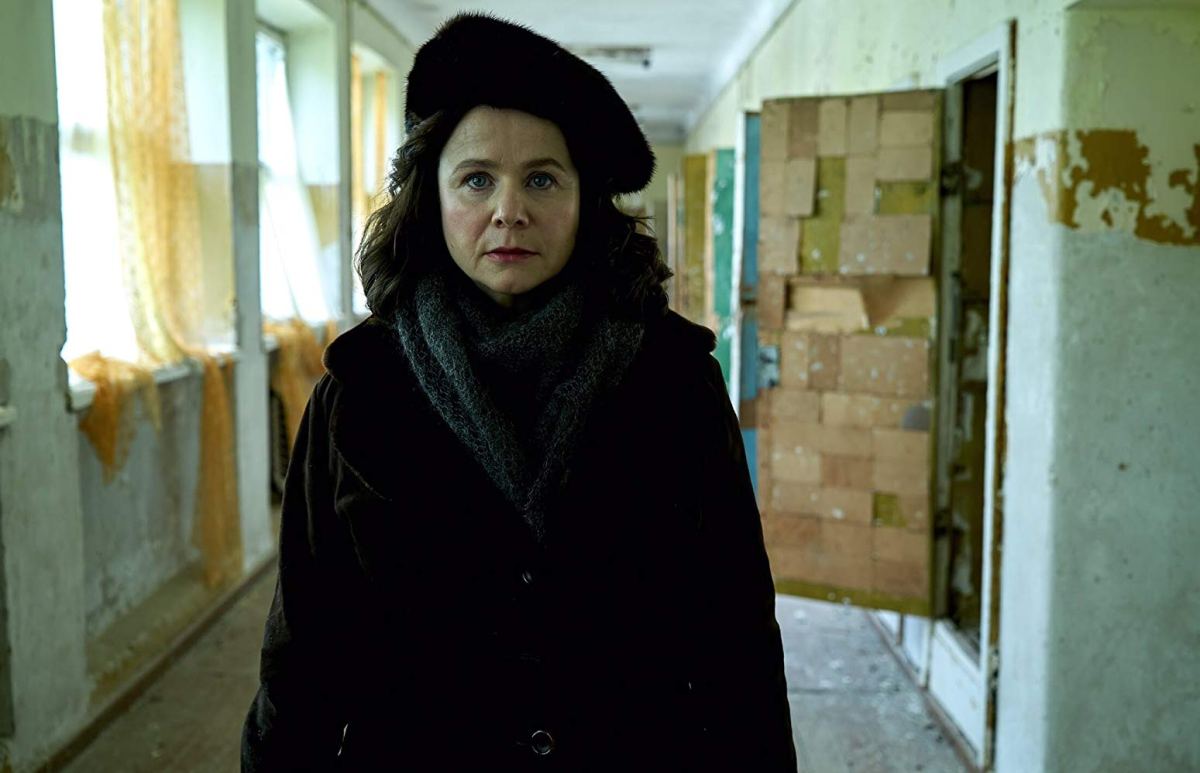
Every now and then I become obsessed with a show that sends me on a quest for knowledge and into a rabbit hole of information. Craig Mazin’s new five part HBO + SKY co-production Chernobyl has done just that. For many, the Chernobyl disaster is a hazy memory we have from our childhoods— relegated to grainy VHS tapes we watched in elementary school or a few paragraphs in our history and science books. But as it turns out, what we learned only scratched the surface…
“There was nothing sane about Chernobyl.”
Part dramatization, part investigation, part history lesson, and part cautionary tale, the first two episodes of Chernobyl narratively demonstrate this won’t just be a story about the events that unfolded in the early morning hours of April 26th, 1986 but rather a story about heroes and villains. About humanity. Though Mazin provides facts akin to those we may have heard before, he wastes no time knocking us back in our seats and into the web of deception spun by the Soviet Union to reveal some of the best— and worst people that emerged from the tragedy. This Chernobyl is a story of bureaucracy in the Soviet Union— of negligence, of a system that would rather let its people believe they were safe rather than admit wrongdoing, and a people willing to risk their lives for their love of the Soviet Union. In Mazin’s Chernobyl, truth is a crime and to admit the Soviet Union had a weakness? perhaps the biggest offense. After all, the World was watching.
“Our faith in Soviet socialism will always be rewarded.”
As Chernobyl opens, we find ourselves two years after the incident occurred in the home of our protagonist, scientist Valery Legasov (biographically portrayed by Jared Harris). In this moment, he’s listening to a recording of himself. “What is the cost of lies?” he asks, before speaking of Chernobyl deputy chief Anatoly Dyatlov (biographically portrayed by Paul Ritter) and his guilt in the events that took place. While he admits Dyatlov deserves nothing short of death, Legasov insinuates there is a far more guiltier party not paying a price— the Soviet Union itself. “Well, I’ve given you everything I know. They’ll deny it, of course. They always do. I know you’ll try your best,” Legasov concludes, recording his closing statement to a mystery recipient before stopping the tape. He gently holds a handkerchief over his mouth before placing it down to reveal it’s stained with spots of blood. Newspaper in hand, he then wraps what turns out to be a series of recordings, hiding them inside a waste bin before retreating outside as a man in a car looks on. He places the recordings inside a loose brick in the wall of his building before returning inside. For Legasov, the cost of lies is overwhelming. This is a man burdened by what we can only assume is failure to fully expose the truth and it has finally caught up with him.
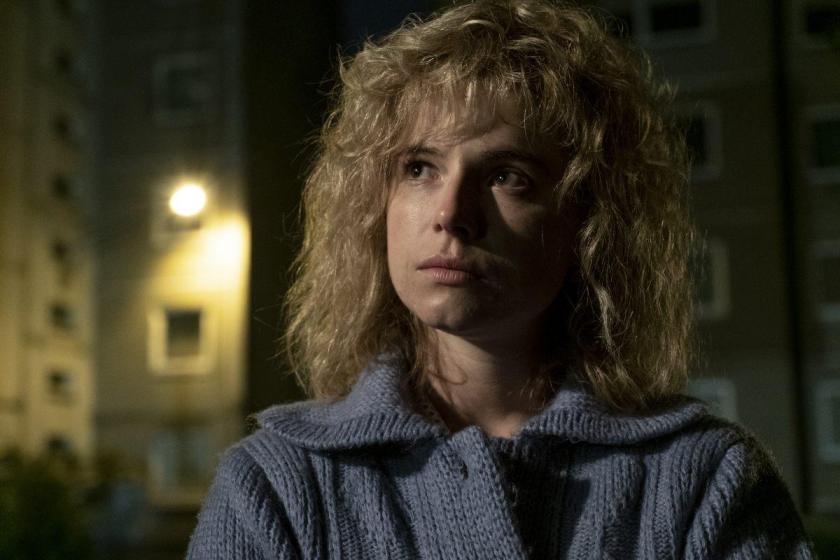
Jessie Buckley as Lyudmilla Ignatenko in Chernobyl
Flashback to Pripyat, Ukraine exactly two years (and one minute earlier) before our miniseries open. We meet a young woman named Lyudmilla (portrayed biographically by Jessie Buckley) who is up early and “ill.” As she leaves the bathroom and heads into her living room, we see an explosion occurring in the distance. Moments after, the house shakes, startling her. Her husband awakens and together, they watch Chernobyl burn a mile away from their home before he receives orders (as a fireman) to head to the scene under the guise it’s just the roof burning. We then meet the group of men in the control room that night as the blast goes off— some an amalgamation suitable for Mazin’s story and others, including Dyatlov, real. We see Dyatlov being told the core has exploded and witness his refusal to believe it (ignorance? arrogance?). He will send men to their deaths to assess the damages— he will send men directly to the core. We meet the Plant Director Viktor Bryukhanov and Chief Engineer Nikolai Formin (portrayed biographically by Con O’Neill and Adrian Rawlins), two men in positions of power who clearly do not have anyone’s interests at heart but their own. They will also send men to the core. They will refuse to believe the truth. They will refuse to recommend Pripyat be evacuated. We will be introduced to Deputy Chairman of the Council of Ministries and head of the Bureau for Fuel and Energy, Boris Scherbina (portrayed biographically by Stellan Skarsgård) who will recruit Legasov to General Secretary Gorbachev’s committee to manage the accident. He will make sure in this committee, Legasov knows his place.
“You’re on this committee to answer direct questions about the function of an RBMK reactor if they should happen to arise. Nothing else. Certainly not policy. Do you understand?”
It doesn’t take long for the miniseries to begin to answer Legasov’s initial question as we see firsthand the devastation that emerges in the moments and hours following the early morning explosion. Make no mistake, while impeccably directed by Johan Renck, shocking is the contrast between what we see at Chernobyl through the eyes of those on the ground, and what the citizens of Pripyat are unaware of— discoloration of skin, coughing, bleeding, vomiting, radiation poisoning— death. An unknowing population watches on bewildered yet enchanted by the beauty of a glowing blue light emanating from the opening of the reactor 4 core, ignorant they are being exposed to high amounts of radiation surpassing the readings on military grade dosimeters (the instrument used to monitor levels of radiation). Chernobyl is difficult to watch because it actually happened. Though some characters are fictionalized (Ulyana Maximovna, a nuclear physicist portrayed by Emily Watson), these people— or a composite of them to serve the narrative, actually existed.
With a beyond eerie score by Hildur Guðnadóttirset against the bleak backdrop of a nuclear disaster and the seemingly endless clicking of the dosimeter (which never fails to increase my anxiety and pulse), Mazin’s words acted out through an amazing cast makes for compelling television as does each episode breakdown he provides on the companion Chernobyl Podcast. I recommend watching first, then listening to Mazin along with NPR’s Peter Sagal as they discuss characters and the inspiration behind the scenes. Mazin has taken a piece of horrific history and dramatized it with care, illuminating the Soviet Union’s role in what could have easily been the end of the European continent while educating us that it all could have been avoidable. Definitely tune in. This will rightfully be an awards contender.
While the first two episodes have aired and are available on HBO GO and HBO NOW, Chernobyl airs now Monday nights through June 3rd @ 9pm on HBO and in the UK on Sky. Its companion podcast is available at the conclusion of each episode.
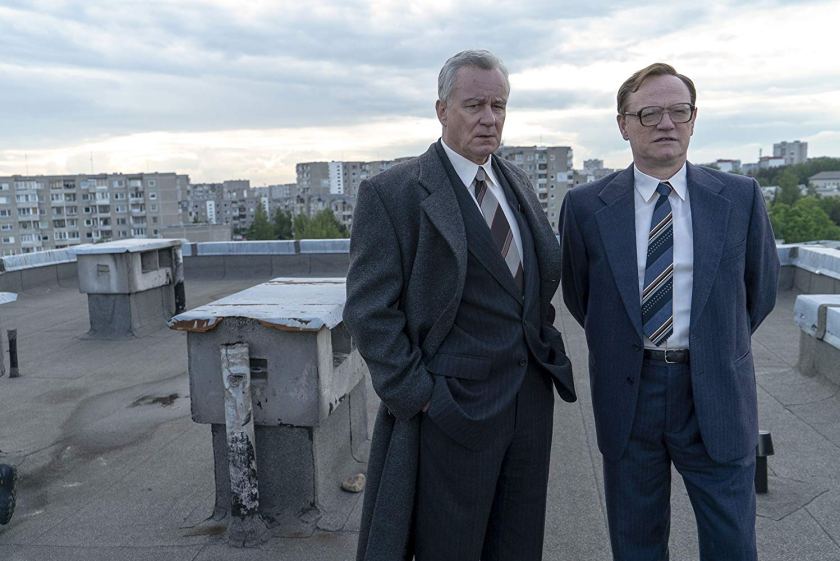 Stellan Skarsgård as Boris Scherbina and Jared Harris as Valery Legasov in Chernobyl
In the event Chernobyl the miniseries isn’t enough for you, take a deep dive and learn more with some of the following:
- Babushka’s of Chernobyl (Amazon Prime) – 2015 documentary that follows a group of strong women who after the Chernobyl disaster, decided to rebel against orders and return to the exclusion zone where they have resided ever since.
- Chernobyl Heart (YouTube) – originally airing back in 2004 on HBO and winner Best Documentary Short Subject award at The 76th Academy Award, Chernobyl Heart is a shocking and heartbreaking glimpse into the lives of the children Chernobyl impacted and continues to today.
- Voices from Chernobyl – while Mazin assured me via Twitter he will be releasing a full bibliography of the material he used to once the miniseries concludes, he has mentioned multiple times in Tweets and the companion Chernobyl podcast that Voices from Chernobyl was a great source of information.

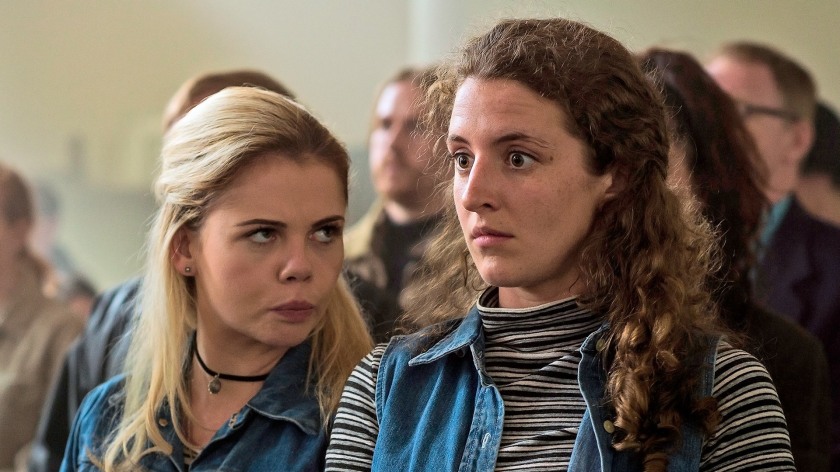 Saoirse-Monica Jackson and Louisa Harland in Derry Girls
 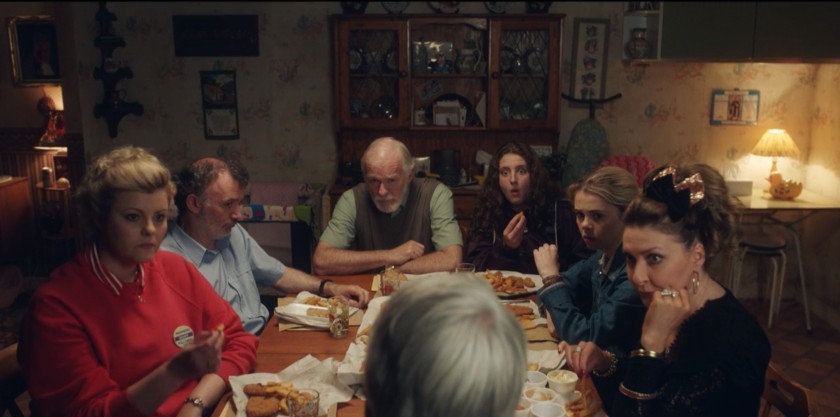 Family Dinner: Ma Mary (Tara Lynne O’Neill), Da Gerry (Tommy Tiernan), Granda Joe (Ian McElhinney), Orla (Louisa Harland), Erin (Saoirse-Monica Jackson) and Aunt Sarah (Kathy Kiera Clarke
 MARISSA MONTICOLO